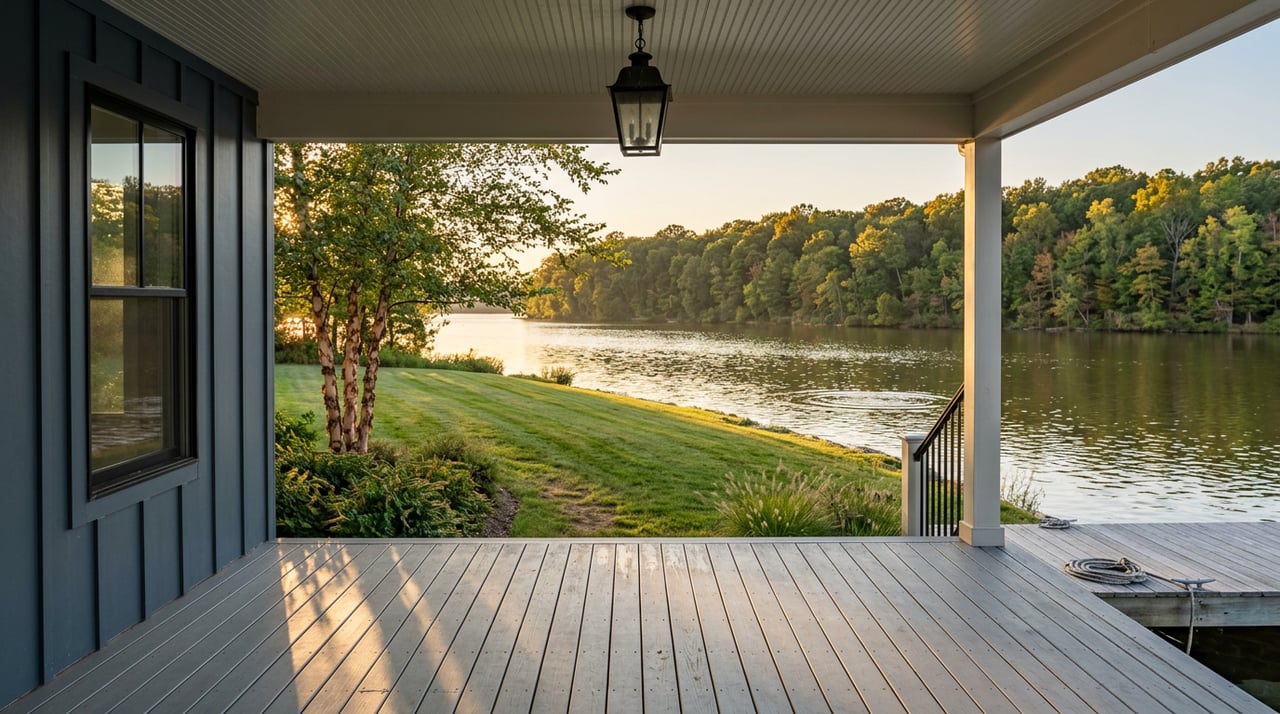
The $750K to $1M Squeeze: What's Really Happening in Cass County's Lake Market
August 13, 2026
August 13, 2026
"You'll see two offers on the same day for something that's sat on the market for a long, long time... Time kills all deals."
That's Paul DeLano, the broker who has led inland lake sales across this region since 2019, describing a pattern that trips up buyers on Diamond Lake, Stone Lake, and the other Cass County shorelines almost every season. A house sits. Buyers assume something is wrong with it, or that the seller is desperate, so they wait for a better opening. Then two offers land on the same day and the house is gone.
That instinct, waiting on a stale listing because time feels like leverage, is exactly backward in one specific slice of the Cass County lake market right now. Understanding why requires letting go of the idea that there's a single "lake market" here at all.
The inland lake market that covers Cass County's shoreline, along with Berrien, St. Joseph, and the southern portions of Van Buren and Kalamazoo counties, isn't moving as a single unit. It has split into three price bands, and each one is behaving on its own logic. Below roughly $750,000, you're in the cottage segment: smaller, often seasonal homes with a broad pool of buyers and a market that moves fast. Above $1 million, you're in a different world entirely, one where buyers have typically already picked a specific lake and are waiting for the right property to appear on it. In between sits the $750,000 to $999,999 band, and that band is where the surprises are.
Here's the comparison as of the most recent reporting, drawn from monthly market data covering the region's inland lakes:
| Price Band | Recent Absorption | Unit Sales Trend (YoY) | Market Lean |
|---|---|---|---|
| Under $300K | 1.47 months | Roughly flat | Strongly seller favored |
| $300K to $749K | 2.71 to 2.90 months | Up 5% to nearly 10% | Seller favored |
| $750K to $999K | 5.68 months (March), 7.32 months (April) | Down 18% (50 to 41 sales) | Buyer favored |
| $1M to $2M | 4.62 months | Up 30% (30 to 39 sales) | Seller favored |
| $2M+ | 17.14 months (small sample) | Up 133% (3 to 7 sales) | Data-thin, but accelerating |
Absorption is simply the number of months it would take to sell every active listing at the current sales pace. Under three months tilts toward sellers. Above six tilts toward buyers. Look at that table again and the pattern jumps out: everything under $750K is tight, everything from $1M up is tightening further, and the one band caught in between has drifted past the six-month threshold into buyer territory. That's not a smooth curve. It's a barbell, heavy on both ends and thin in the middle.
If your search is under $750,000, don't expect the softness described below to reach you. Every band under that threshold has absorbed in three months or less, with the entry tier under $300,000 sitting at a remarkable 1.47 months as of the March 2026 reading. The $300,000 to $499,000 band posted close to 10% unit sales growth over the trailing year. This is the segment where a well-priced, well-maintained property still draws quick, serious interest, and where waiting on a "stale" listing rarely pays off the way it might a few price bands up.
The $750,000 to $999,999 band tells a different story, and it's the one worth understanding before you write an offer or set a list price anywhere near it. Unit sales in this range fell from 50 to 41 over the trailing twelve months through April 2026, an 18% drop. Absorption moved from 5.68 months in the March reading to 7.32 months by April, crossing past the conventional six-month line that separates a balanced market from one that favors buyers.
That shift changes what a seller in this band should expect at the negotiating table. Sellers here now face more inspection-related repair requests and concessions than they did two years ago. The ones who address legitimate findings are closing. The ones who treat every request as an attack are watching their listings age, which brings us back to the opening quote: age on a listing in this specific band doesn't automatically signal a problem with the house. It increasingly signals that this is simply how the $750K to $999K market moves right now, slower, with more room for buyers to negotiate on condition rather than just price.
For buyers, this is the band where patience and a careful inspection strategy actually pay off, in contrast to the cottage segment where hesitation costs you the house.
Above $1 million, the story flips again. Combined luxury sales rose 53% over the trailing twelve months through April 2026, climbing from 30 units to 46. Split further, the $1M to $2M range grew 30% (30 to 39 sales), while the $2M-plus tier more than doubled, from 3 units to 7, a 133% increase. The base is small enough that a single additional sale swings the percentage significantly, but the direction across two consecutive reporting periods is consistent.
Diamond Lake in Cassopolis is where this demand shows up most visibly. It's a large all-sports lake, just over 1,000 acres with more than 9 miles of shoreline and a 43-acre island near its center, close enough to Chicago (roughly two hours) and Notre Dame (about 45 minutes) to draw second-home buyers from both. The lake supports its own small ecosystem: the Diamond Lake Yacht Club runs regattas and youth sailing programs, Cassopolis Brewing Company pours craft beer out of the town's former fire station, and Twirl Ice Cream Parlor and the Diamond Lake Orchard & Winery round out the seasonal routine. A few miles over, the Cass County Fairgrounds hosts the annual county fair along with concerts through the summer. Buyers shopping this tier aren't just buying square footage. They're buying into a lake with an established community and a limited number of properties that will ever change hands.
That scarcity is structural, not seasonal. Over the past three years, the broader inland lake market has consistently produced fewer unit sales alongside rising average prices, the signature of a market where supply can't expand to meet demand. Shoreline is fixed. Magician Lake illustrates the pattern clearly: fewer homes changed hands there in 2025 than the year before, even as prices held. On some lakes, only two or three properties list in an entire year, which is why serious buyers targeting a specific shoreline often run alerts and wait for months or longer before the right listing appears.
Zoom out to the full 2025 picture and the averages look calm. The region recorded 297 transactions totaling $185 million in sales volume for the year, with an average sale price of $624,000 and a median of $522,000, both essentially flat compared to 2024. Values sit roughly 47% above 2020 levels and 66% above pre-pandemic pricing, a permanent repricing rather than a bubble that's since deflated. About 41% of 2025 lake transactions closed in cash, which is one reason this segment responds less sharply to mortgage rate swings than a typical subdivision listing does; these are largely second homes and lifestyle purchases, not rate-dependent moves.
None of that stability shows the split happening underneath it. A flat median doesn't tell you that the $750K to $1M band has quietly become the most negotiable price point on Cass County's lakes, or that the tier above it is accelerating fast enough to double its transaction count in a single year. If you're comparing what a lake budget actually buys today, the price band you're shopping in matters more than the countywide average ever will.
Does this data apply to every lake in Cass County the same way? Not evenly. The regional figures blend Diamond Lake, Eagle Lake, Stone Lake, Donnell Lake, and neighboring lakes across Berrien and St. Joseph counties too. A specific lake with only two or three annual listings can defy the broader trend in either direction, which is why the individual property and its lake matter more than the countywide number.
If my home falls in the $750K to $999K range, do I need to drop my price to sell? Not necessarily. The shift here is more about expected negotiation, particularly around inspection items, than about pricing itself. A correctly priced home in this band still sells. It may simply take longer and involve more back-and-forth on repairs than it would have two years ago.
Should I wait for the middle band to tighten back up before listing? That depends on your timeline and your lake. Given that supply on inland lakes doesn't expand, waiting carries its own risk if your goal is timing the market rather than making a life decision. Talking through your specific lake, price point, and timeline with someone who tracks these bands closely will tell you more than any regional average can.
Whether you're weighing a move into the cottage tier, sitting right in that $750K to $1M range, or watching Diamond Lake for the right listing above $1 million, the number that matters is the one specific to your price band and your lake, not the countywide headline. Christy Cottingham works with buyers and sellers across Cass County and the wider Southwest Michigan lake corridor and can walk through what your particular situation looks like against this data. Let's Connect.
Stay up to date on the latest real estate trends.
Get assistance in determining current property value, crafting a competitive offer, writing and negotiating a contract, and much more. Contact me today.
Contact Details
Christy Cottingham
M: (517) 937-0826
O: (517) 782-2996
[email protected]
Address
910 N West Ave
Jackson, MI 49202